Quantum Maze Search
A modernized Qiskit demonstration that prepares three encoded maze paths and uses generalized Grover amplitude amplification to select a designated exit path.
 Repository output / project interface
01 / Overview
Project overview
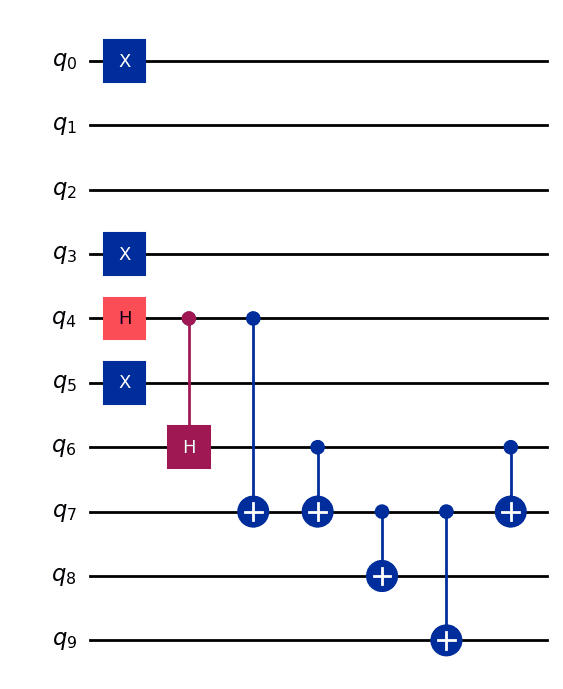
Built with Joseph Turcios, this educational proof of concept combines a classical binary-tree maze with a 10-qubit quantum circuit. Three candidate paths are encoded into a prepared state, and a generalized amplitude-amplification operator raises the marked target from an initial probability of 0.25 to an ideal probability of 1 after one iteration.
02 / Motivation
The problem
The project is a concrete way to study state preparation, reversible marking, diffusion about a non-uniform prepared state, and the difference between a quantum demonstration and a general-purpose solver.
03 / Method
Technical approach
The modern implementation replaces deprecated Qiskit APIs with AerSimulator, transpilation, backend execution, deterministic seeds, reusable functions, assertions, and tests. It uses the operator Q = A S0 A-dagger Sf so the reflection matches the prepared maze-path state instead of assuming a uniform superposition.
04 / Reflection
What I learned
The modernization clarified that honest algorithm descriptions matter: oracle construction, state preparation, compilation, and hardware noise are part of the computational cost, not footnotes.