Computational Orbital Mechanics
A tested Python package for two-body orbit propagation, reference-frame conversion, ground tracks, observer geometry, and analytical-to-numerical Hohmann transfer validation.
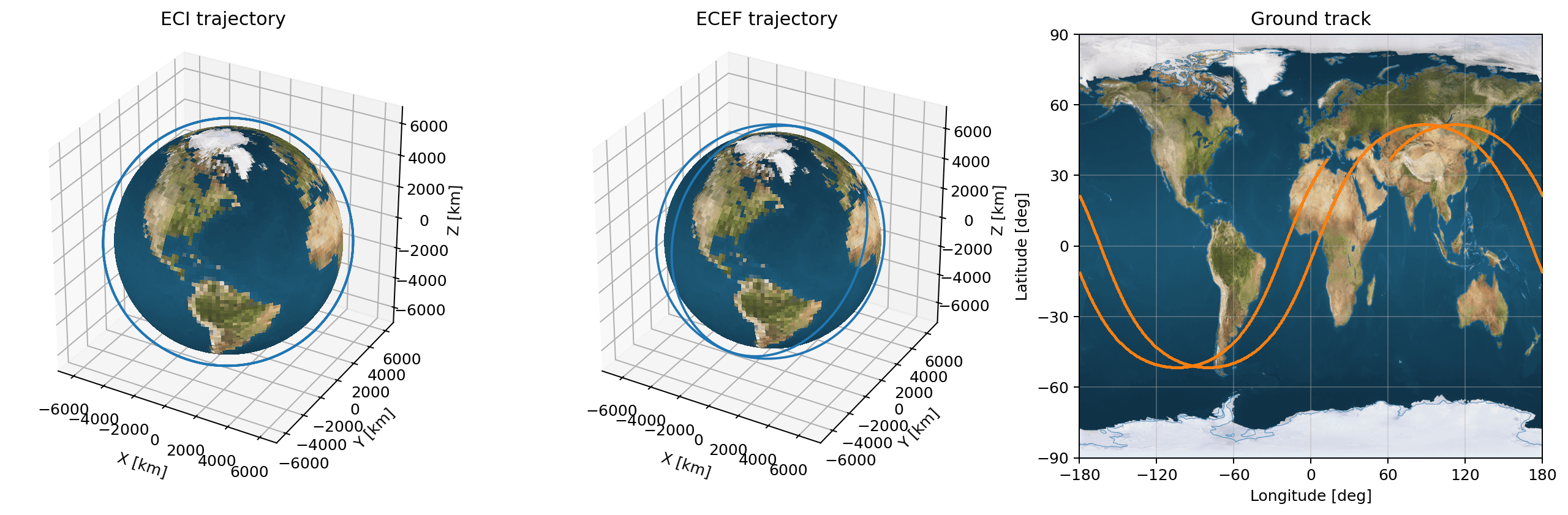 Repository output / project interface
01 / Overview
Project overview
This project modernizes two computational-physics notebooks into a reusable package. It propagates trajectories from classical orbital elements, converts between ECI and ECEF frames, maps ground tracks, calculates observer look angles, and compares analytical Hohmann transfer results with numerical propagation.
02 / Motivation
The problem
Orbital transfer equations become more useful when they sit inside an inspectable workflow that connects initial conditions, reference frames, numerical integration, visualization, and automated validation.
03 / Method
Technical approach
The package separates elements, propagation, frames, visibility, transfers, and plotting into tested modules. For a 400 km circular parking orbit to a 42,164 km target radius, it reproduces a total delta-v of about 3.854 km/s and a transfer time of about 5.291 hours, then checks the numerical trajectory against the target radius and circular speed.
04 / Reflection
What I learned
The strongest simulations pair analytical checks with numerical results and make frame definitions and model assumptions explicit from the start.